
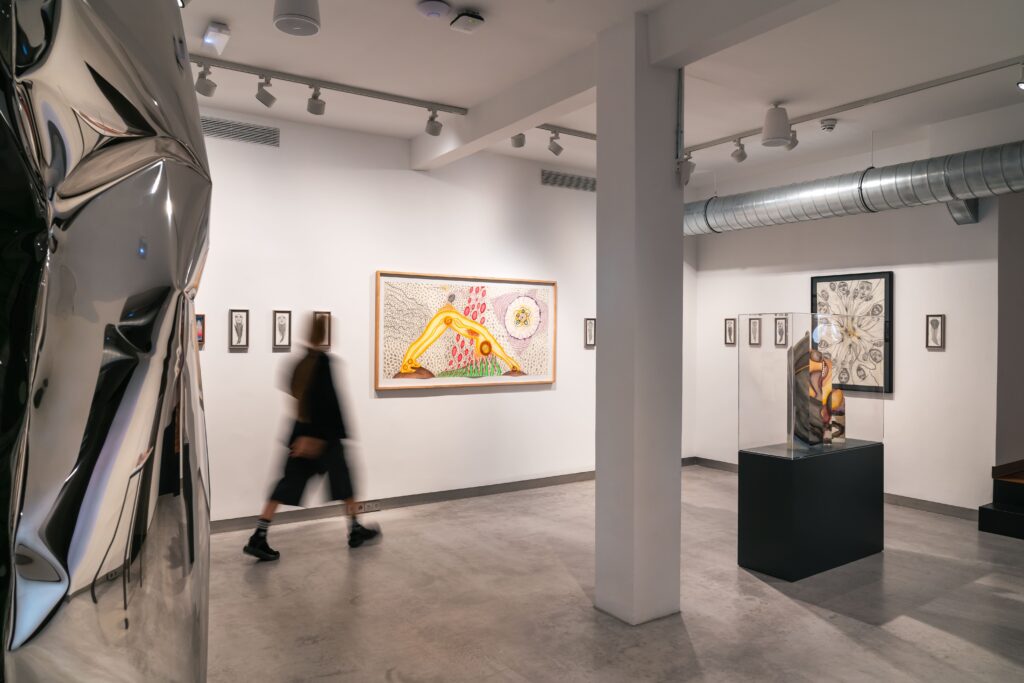

Movimiento 37, an initiative dedicated to connecting the global art community through exhibitions and artistic residencies, presents Criaturas Híbridas, an exhibition curated by Galería SENDA bringing together works by Evru/Zush, Gonzalo Guzmán, and Sandra Vásquez de la Horra. The exhibition arrives in Madrid as part of a project that opens its space at SOLO CSV to proposals from galleries, collections, and institutions, fostering encounters and new connections between different agents within the art scene.
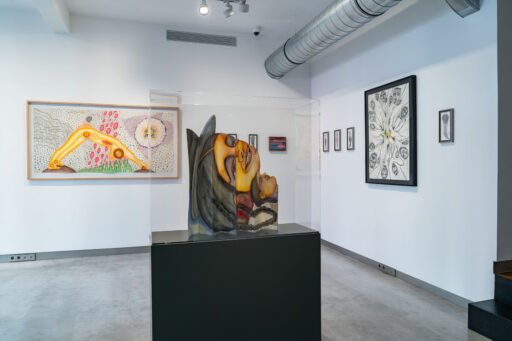
Criaturas Híbridas takes transformation as an inherent condition of the image and proposes a journey through three artistic universes in which the boundaries between traditionally separate categories — the human and the animal, the organic and the artificial, dreams and reality — become permeable. In the works of Evru/Zush, Gonzalo Guzmán, and Sandra Vásquez de la Horra, hybridity acts as a principle of connection, bringing together elements from different orders and giving rise to forms that resist definitive classification.
The exhibition finds one of its precedents in Un autre monde, published in 1844 by French illustrator Jean-Ignace-Isidore Grandville. His hybrid creatures, metamorphoses between species, shifts in scale, and unexpected associations constructed a universe in which taxonomies lost their stability and the boundaries between the human, the animal, and the artificial became blurred. More than a century later, Max Ernst would recognise in these images the ability to turn metamorphosis into a way of thinking.
Within this genealogy, the work of Barcelona-born artist Evru/Zush (1946–2025), a singular figure in contemporary Spanish art, takes transformation to the scale of a cosmology. Born Albert Porta, in 1968 he adopted the identity of Zush and created the Evrugo Mental State, an autonomous territory with its own geography, writing system, cartography, currency, symbols, and citizenship. In 2001, coinciding with his retrospective at MACBA, Zush became Evru, defined by the artist himself as ArtCienMist, a synthesis of artist, scientist, and mystic. Over more than five decades, he constructed a creative universe in constant transformation, in which writing becomes an organism, signs acquire life, and identities multiply into figures that combine the human, the animal, the sexual, and the mental.
Gonzalo Guzmán (Madrid, 1991) approaches transformation through matter. Initially trained as an industrial designer and later turning to sculpture, his practice draws on images that emerge from experiences of lucid dreaming, which he translates into physical space through stainless steel sculptures. His works occupy an intermediate territory between organism and artefact, vision and object, while their reflective surfaces incorporate changes in the surrounding environment and the presence of the viewer, causing their identity to be reconfigured with every gaze.
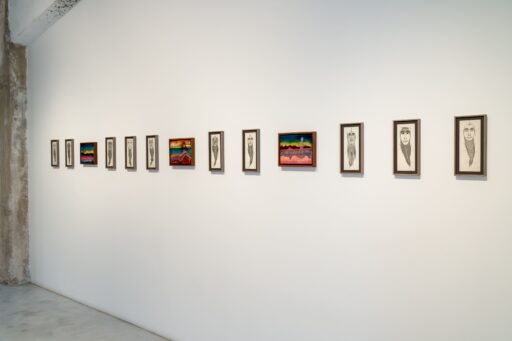
For her part, in the drawings of Chilean artist Sandra Vásquez de la Horra (Viña del Mar, 1967), who lives and works in Berlin and whose work forms part of collections including those of MoMA and the Centre Pompidou, transformation runs through the body. Nature, desire, memory, spirituality, history, and myth intertwine in figures that extend the human towards the animal, the vegetal, and the sacred. Her creatures bring together intimate experiences, popular narratives, and political memories within permeable anatomies in a state of constant transition.
Language, matter, and the body thus constitute three dimensions of the same investigation. In Evru/Zush, the sign acquires the capacity to generate an entire cosmology; in Guzmán, forms emerging from dreams take on material presence while remaining open to the variations of the gaze; and in Vásquez de la Horra’s works, the body brings together species, memories, and symbols that transform into one another. In this sense, Carlos Durán, director of Galería SENDA, explains that the exhibition “brings into dialogue the work of three artists from very different generations and backgrounds, who nevertheless explore realities that we do not necessarily perceive with our eyes. Worlds that we know exist, that we sense and recognise when they are made evident to us, but that are not necessarily formally accepted.”
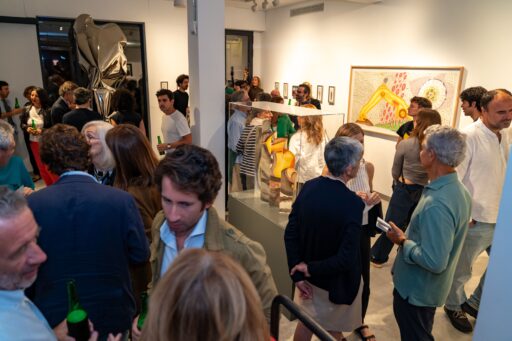
“Movimiento 37 was born from SOLO’s desire to open its spaces to other perspectives and ways of understanding contemporary art. We want it to be a meeting place, where artists, galleries, and institutions can develop their own projects and generate new connections. The collaboration with SENDA embodies precisely this way of working: sharing a space, making room for an independent curatorial proposal, and building a dialogue that can continue beyond the exhibition,” explains Ana Duijm Chávarri, director of Movimiento 37.
Criaturas Híbridas can be visited free of charge until 21 November at Movimiento 37, with access from 13 Ilustración Street, or with free admission combined with the other exhibitions at the centre through its entrance at 36 Cuesta de San Vicente.