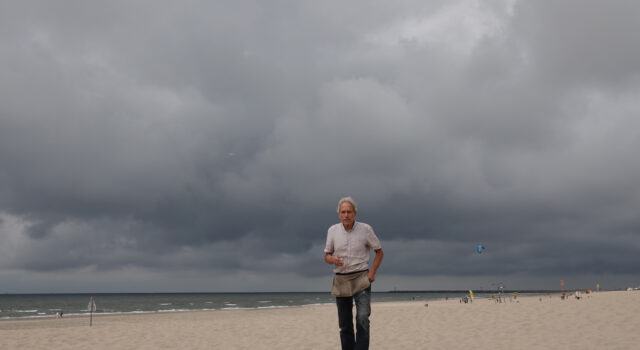

Theo Jansen is a Dutch artist and inventor whose career has always been balanced between art and science. Trained in physics at Delft University, he quickly found that his curiosity reached beyond the laboratory. Early in his practice he experimented with painting, writing, and kinetic objects, even launching a flying saucer installation over Delft in the 1980s that fooled many into believing in UFOs. This mix of playfulness, engineering, and imagination set the foundation for a career defined by works that cross boundaries—half art, half experiment in applied science.
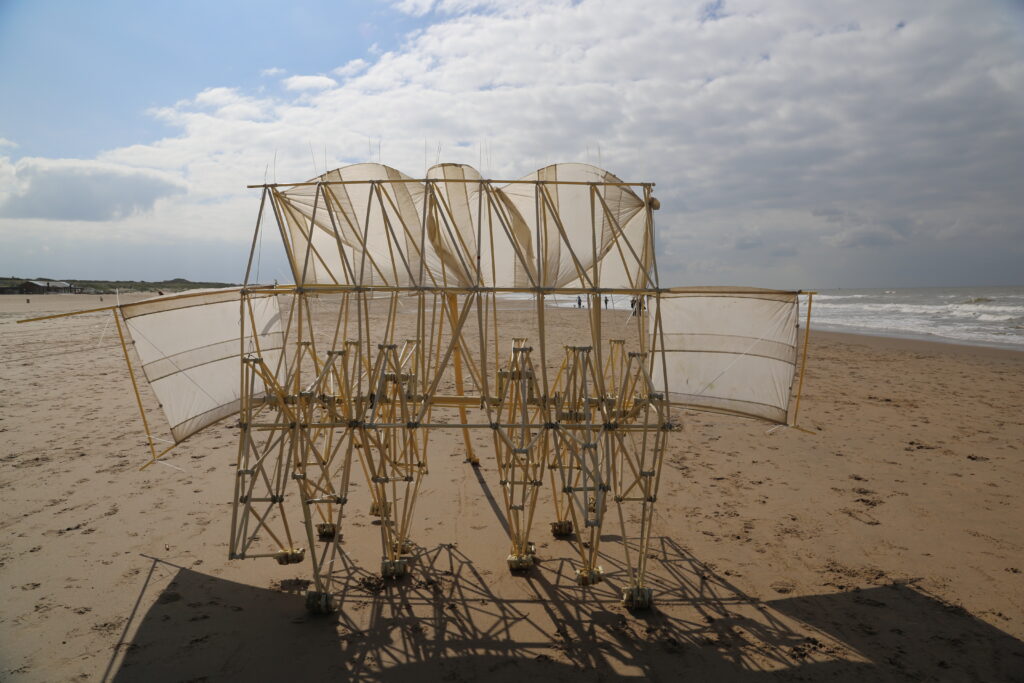
He’s most famous for the Strandbeests—giant wind-powered skeletons made of PVC that walk the beaches like living organisms. But his work isn’t limited to those creatures. Jansen has built interactive machines, experiments with light, and kinetic projects that all share the same obsession: how to create new forms of life out of simple materials and clever mechanics. His process is almost evolutionary—trial and error, testing joints like mutations, and seeing which “species” survive in the wind. He often says that art and engineering can be the same thing—it all depends on how far you let your imagination take it.
Over the years his work has been shown in major museums like Kunstmuseum Den Haag, Palais de Tokyo in Paris, and the Exploratorium in San Francisco, and his Strandbeests have walked beaches all over the world. He’s been awarded prizes like the Witteveen+Bos Award for Art+Technology and the Hague Culture Prize, but what really defines his career is how he’s blurred the lines between disciplines. Jansen has turned plastic tubing, code, and mechanics into something strangely alive—proof that creativity and invention are just two sides of the same coin.