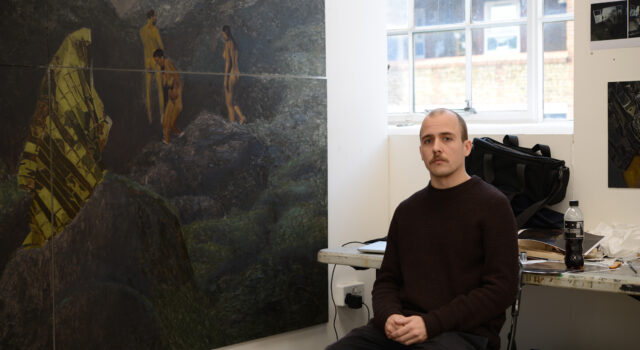

William Reinsch is a British figurative painter whose work explores vulnerability, anxiety, isolation, and the psychological complexity of the human experience. Now based in London, Reinsch developed his artistic practice largely outside formal art education, initially turning to drawing and painting as a way of giving visual form to emotions that were difficult to articulate. What began as a personal means of expression gradually became the foundation of a distinctive painting practice.
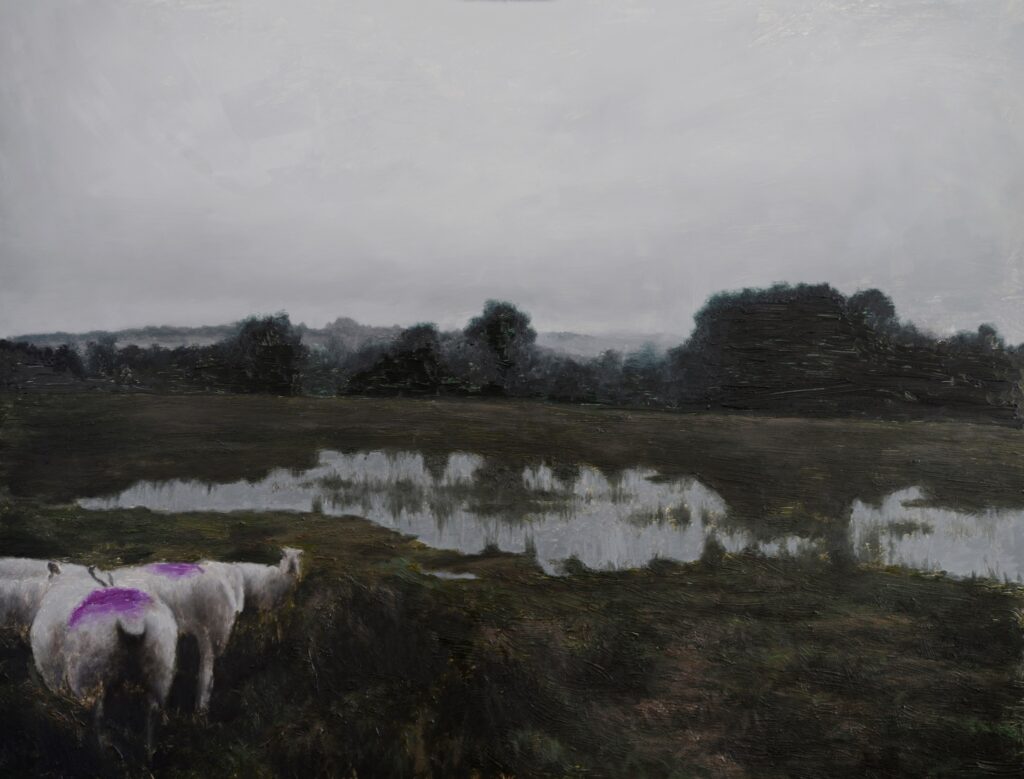
Reinsch works primarily with oil, creating images that combine recognizable human figures with unsettling, dreamlike environments. His paintings often place vulnerable or exposed bodies within atmospheric landscapes, using unusual colours, distorted forms, darkness, and fog to create a sense of psychological tension. The human body becomes both a physical presence and a vehicle for emotional states, allowing the artist to investigate the relationship between the visible and the internal.
A major part of Reinsch’s practice is Naked Island, an ongoing body of work that he began developing in the late 2010s. Conceived as a fictional world with its own atmosphere, characters, and unresolved narratives, the series brings together isolated landscapes, enigmatic figures, fluorescent skin tones, and recurring motifs such as fog and sheep. Reinsch has described the project as being influenced by the mysterious worlds of Twin Peaks and Silent Hill, while cinema, particularly the work of Stanley Kubrick, has played an important role in his visual thinking.
His work has been exhibited in the United Kingdom at institutions and events including the Royal Academy of Arts Summer Exhibition, Saatchi Gallery, London Art Fair, and Castlegate House Gallery. In 2026, his Naked Island series was presented in a solo exhibition at Twilight Contemporary in London.
Through his combination of figurative painting, cinematic atmosphere, and psychological ambiguity, Reinsch constructs worlds that remain deliberately open to interpretation, inviting viewers to confront both the vulnerability of the human figure and the uncertainty of the environments surrounding it.