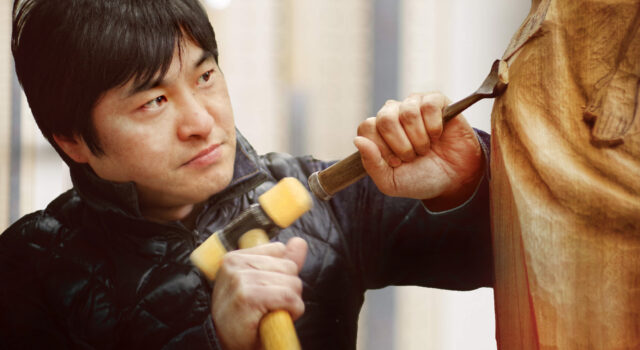

Originally from Chiba, Japan, Kanemaki’s work stands out for its mix of technical mastery and psychological depth. He studied sculpture at Tama Art University in Tokyo, where he graduated in 1999, developing a strong foundation in traditional Japanese carving. Growing up fascinated by transformation—whether through toys, origami, or everyday observation—he’s always been drawn to how a single form can hold multiple identities. That idea has stayed with him and now defines much of his artistic language.
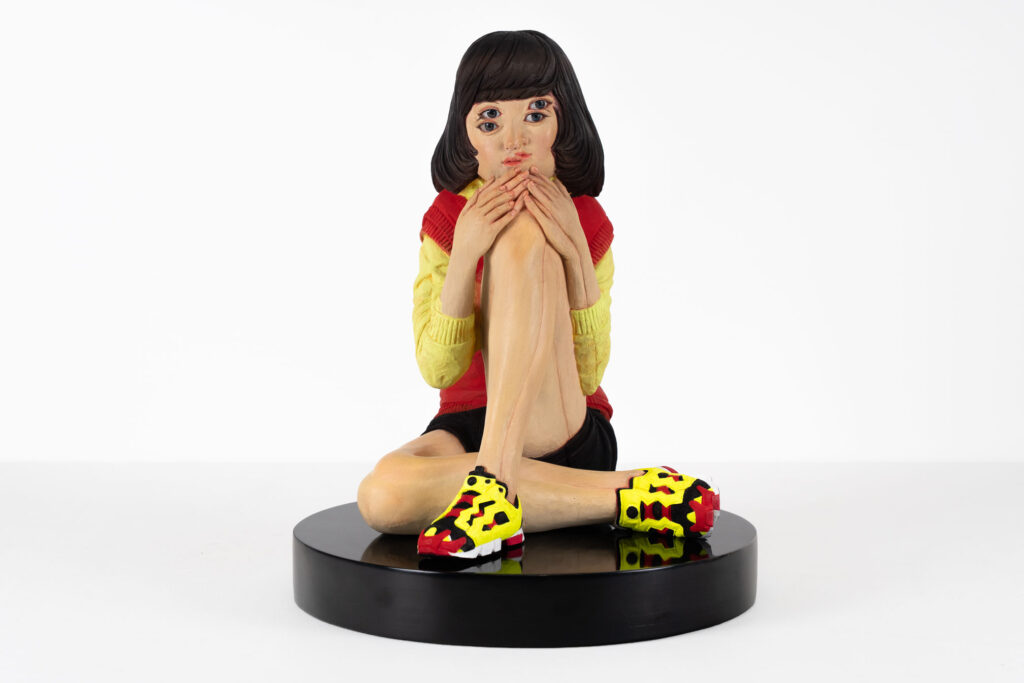
Kanemaki works primarily with camphor wood using the Ichiboku zukuri technique, carving each piece from a single block. His sculptures are human, yet they fracture, multiply, or distort — figures that seem to glitch or shift in time. Through these surreal distortions, he captures conflicting emotions: joy and fear, life and death, harmony and chaos. Each piece, painted in subtle or pastel tones, feels both tender and unsettling, forcing viewers to confront the instability of human emotion and perception. His work blurs the boundary between realism and the psychological, traditional craft and contemporary vision.
His career includes solo exhibitions in Tokyo and Taipei, with key showcases at FUMA Contemporary Tokyo and Elsa Art Gallery. In 2025, his exhibition Insight Prism at FUMA Contemporary presented one of his most ambitious sculptures to date. His works have also appeared in shows like Cicada Sensibility (2021), and several have been featured in international auctions, highlighting his growing presence in the global art scene. What Kanemaki values most in his practice is connection — using traditional techniques to express the modern condition, where beauty, tension, and multiplicity coexist within the same body.